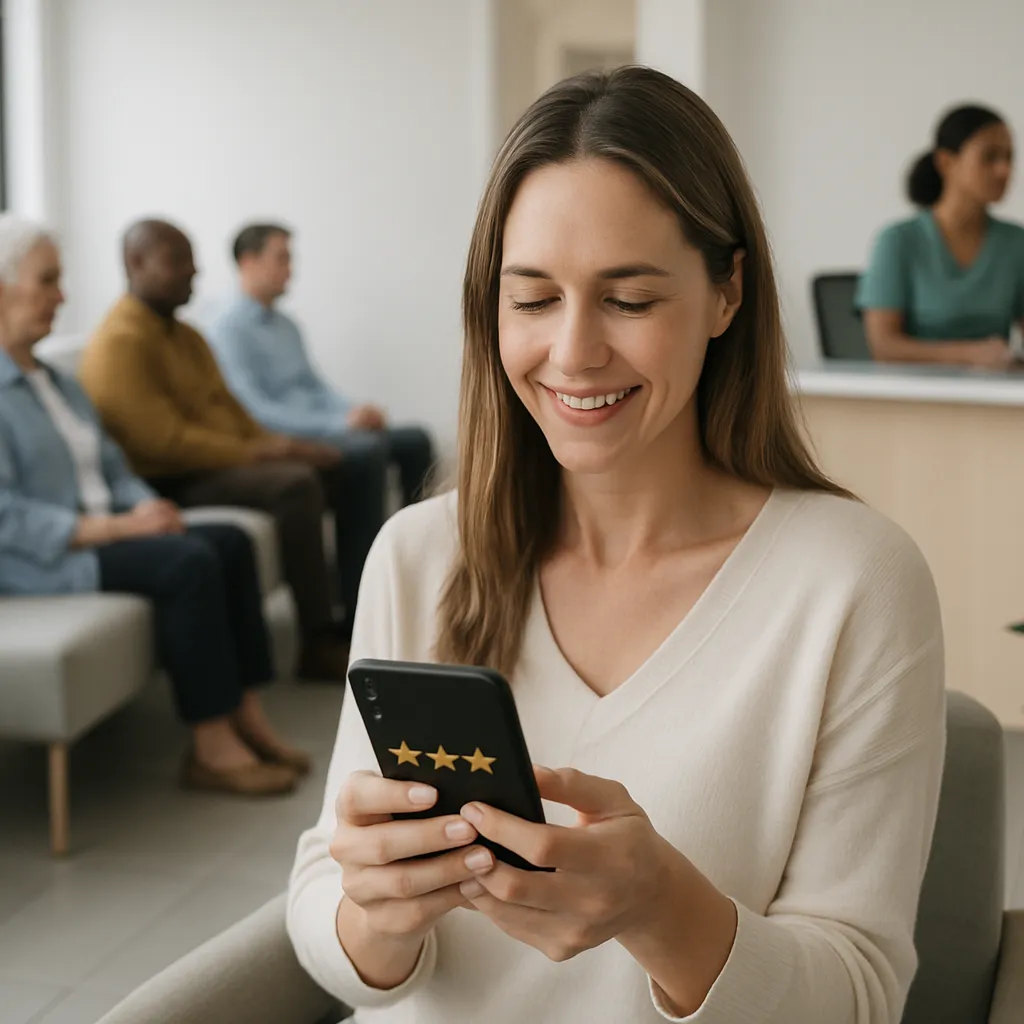
You open Google on a Monday morning and your stomach drops. Four bad Google reviews in the last ten days. Two of them long, angry, and specific. One from a name you do not recognize. Your star rating slid from 4.7 to 4.3, and the front desk phone is quieter than usual.
If that is where you are right now, take a breath. A wave of bad Google reviews feels like a fire, but it is not the end of your practice. It is a signal, sometimes about a real operational problem, sometimes about a single frustrated person with a wide reach, and sometimes about a competitor playing dirty. The recovery playbook is the same either way, and the practices that work it calmly usually come out stronger than before.
Here is how to think about the next 30 days.
Why a Wave of Bad Google Reviews Feels Worse Than It Is
The math on Google reviews is unforgiving in the short term. If you have 80 reviews at 4.8 stars, four one-star reviews in a week drops you to roughly 4.6. That looks small on paper, but Google’s local ranking and human perception both amplify recency. New reviews are weighted more heavily in how the profile is displayed, and prospective patients scroll the most recent ones first.
So yes, bad Google reviews hurt more when they cluster. That is why the first instinct, panic, is understandable. It is also why the second instinct, firing back at reviewers publicly, is the most damaging thing you can do. Every response you write is a permanent piece of marketing collateral. Future patients will read it and decide whether they want to hand you their body and their trust.
Before you touch the keyboard, slow down and do triage.
Step One: Triage Every Review Before You Respond
Pull all the recent negative reviews into a single document. For each one, mark it as one of four types.
Legitimate patient complaint. A real person had a real experience and it went poorly. Long wait, billing surprise, feeling dismissed by a provider, rude front desk interaction. These are gifts, even when they sting.
Misunderstanding or expectation gap. The patient is real but the complaint is based on something outside your control or a misread of policy, like insurance coverage, a referral requirement, or a treatment timeline.
Fake or malicious. No record of the person, oddly generic language, reviewer profile with a suspicious pattern, or a coordinated cluster from the same day. Handle these differently, and see our guide on how to handle a fake Google review on your practice before you respond publicly.
Off-topic or policy violation. Reviews about a family member’s experience, reviews about a doctor at a different location, reviews that contain a competitor’s name, or reviews that reveal protected health information the reviewer did not have the right to share.
This triage matters because your response strategy is completely different for each bucket. Lumping them together and firing off the same apologetic template makes the legitimate complaints look performative and the fake ones look confirmed.
How Should You Respond to Bad Google Reviews Publicly?
Here is the hard part for medical practices. You cannot respond the way a restaurant would. HIPAA does not go away because a patient waived their own privacy by posting. If you confirm they were a patient, describe their visit, quote their chart, or even reference a specific service they received, you have created a compliance problem that is far worse than the review itself.
The safe formula for a public reply to bad Google reviews looks like this. Acknowledge the feeling, not the facts. Invite them offline to a specific person and channel. Keep it under four sentences. Never confirm or deny that the reviewer is or was a patient.
Something like: "We’re sorry to hear about your frustration. Patient experience is important to us, and we’d like to understand what happened. Please contact our office manager, Sarah, at 555-1234 so we can talk directly."
That is it. No defense, no clinical context, no explanation of policy. If you want to see the compliance boundaries in more detail, we walk through them in why HIPAA makes review responses risky and how to do it right. This is general information, not legal advice, so run your final response templates by your compliance counsel.
Respond within 48 hours if you can. Slower than that and prospective patients assume you are ignoring feedback.
What About Reviews You Believe Are Fake?
Flag them through Google Business Profile. In the review, click the three-dot menu and report it. Use the categories carefully, most fake reviews fall under "off topic," "conflict of interest," or "spam." Then follow up with a written appeal through the Business Profile Help contact form. Google’s own policies on prohibited and restricted content are published in their Business Profile content policy, and quoting the specific violation in your appeal helps.
Do not respond publicly to obvious fakes with accusations. It looks defensive, and if the review is later removed your accusation vanishes with it while the impression you left on readers does not. A short, neutral acknowledgment or no response at all is usually better while removal is pending.
And no, we do not recommend paying a reputation firm to make them disappear. There is a whole conversation about why in our take on review removal services for medical practices.
The Real Fix: Fix the Thing That Caused the Wave
Waves usually have a source. Four bad Google reviews in ten days is rarely random. Before you focus on rebuilding your rating, sit down with your team and find the pattern.
Look at dates and timing. Did the reviews all come from a single week when you were short-staffed? Did a specific provider see all the unhappy patients? Was there a billing statement batch that went out just before? Did you switch schedulers, EMRs, or phone systems recently?
Look at themes. Long waits. Rude front desk. Unreturned calls. Confusing billing. Rushed appointments. Patterns tell you where the operational leak is.
Common culprits we see over and over. Phones ringing out because the front desk is drowning, which is why so many practices are moving to hybrid answering setups and getting help from tools that stop losing patients to phone tag with two-way texting. Angry callers being handled poorly under pressure. Portal messages sitting for days. New patients waiting three weeks for a first visit when a competitor offers same-day slots.
Fix the operational cause before you launch a review-generation campaign. Otherwise you are just pumping fresh water into a leaky bucket, and the next wave of bad Google reviews will land in six weeks.
How Do You Rebuild Your Star Rating After a Bad Stretch?
Math again. If you sit at 4.3 with 80 reviews, you need roughly 40 new five-star reviews to climb back to 4.6. That is doable in 60 to 90 days for most practices if you build a repeatable system.
The core idea is simple. Ask happy patients at the moment they are happiest, make the ask easy, and never incentivize. Buying, trading, or offering discounts for reviews violates Google’s policies and can get your profile suspended, which is a much bigger fire than a few bad Google reviews.
Timing matters more than volume. The best moment to ask is right after a positive interaction, usually at checkout after a successful visit, or within an hour or two while the feeling is fresh. A text message with a direct link to your Google review page converts several times better than a card handed at the desk.
Your front desk needs a light script, not a hard pitch. Something like: "Glad today went well. If you have a minute, a quick Google review really helps other patients find us." Then a text with the link goes out automatically. We wrote a longer piece on this exact conversation in how to ask patients for reviews without sounding desperate, and it is worth reading before you brief your team.
Automation makes this consistent. Review request texts triggered off appointment status changes, filtered so you are not asking patients who had a difficult visit, and paced so Google does not see a suspicious burst. A steady flow of 15 to 30 genuine new reviews a month buries a bad stretch faster than any cleanup service ever will.
What Bad Google Reviews Actually Do to Your Local Rankings
There are two effects, and it is worth separating them.
The direct SEO effect. Google’s local ranking algorithm uses review count, average rating, and review recency as factors in the local pack. A rating drop from 4.8 to 4.3 will not knock you out of the map, but combined with fresh negative sentiment and reduced click-through, it can absolutely soften your position. If you rely on map-pack visibility, this matters, and our guide to getting your practice into Google’s local 3-pack covers the full picture.
The click-through effect. This is bigger and faster. When patients search "family doctor near me" and see three listings, the one with 4.8 stars gets clicked more than the one with 4.3, even if the 4.3 practice ranks first. You lose the clicks even when you win the ranking. That is why rebuilding rating is often more valuable than chasing another position on the map.
Track both. Watch your Google Business Profile insights for calls, direction requests, and website clicks over the next 90 days. If those numbers hold steady while your rating recovers, you caught it in time.
The Long Game: Making Your Practice Hard to Damage
The practices that shrug off waves of bad Google reviews all share a few habits. Consistent review flow so any single week’s negatives get diluted quickly. A small, trained team that responds within 48 hours with the same compliant tone every time. An operational culture that treats every complaint, public or private, as data instead of an attack. And a marketing partner who is watching all of this and telling you when the pattern shifts.
This is also where working with an agency that only takes a couple of practices per specialty in your area matters. At DoctorRadius we cap it at two practices per specialty per market, which means when your reputation shifts we notice, we know the local competitive picture, and we are not managing 40 dermatology groups at once. When a wave hits, someone is actually paying attention to your bad Google reviews the same day, not next month.
Recovery from bad Google reviews is not glamorous. It is triage, honest operational fixes, patient responses, and a slow drumbeat of new happy voices. Do those four things for 90 days and the wave becomes a footnote instead of a turning point.
Most practices see rating recovery within 60 to 90 days if they fix the operational cause and generate 15 to 30 new genuine reviews per month. Perception recovery among new patients usually catches up within one to two quarters.
Generally no. Google only removes reviews that violate its content policies, such as spam, conflict of interest, off-topic content, or prohibited material. A negative but genuine patient opinion will not be removed even if you disagree with it.
No. Confirming someone was a patient or referencing their care in a public reply can violate HIPAA, even if the patient revealed the information first. Keep responses short, empathetic, and move the conversation offline.
References
- Google Business Profile, Prohibited and restricted content policy: https://support.google.com/contributions/answer/7400114
- U.S. Department of Health and Human Services, HIPAA Privacy Rule guidance: https://www.hhs.gov/hipaa/for-professionals/privacy/index.html